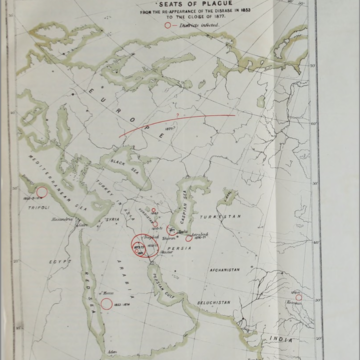
Plague in the Nineteenth Century: Epidemiological and Epistemological Connections
Monday 6 - Tuesday 7 July 2026
Seminar Room 56, Schwarzman Centre for the Humanities
Deadline for Abstracts: Wednesday 15 April 2026
Workshop Overview
We are pleased to announce a call for abstracts for a one-and-a-half-day interdisciplinary workshop on "Plague in the Nineteenth Century: Epidemiological and Epistemological Connections."
The workshop invites early, mid-career and/or senior scholars in history, anthropology, bio/archeology, epidemiology, infectious disease, microbiology, critical animal studies, and related disciplines whose work interrogates plague in its biological as well as historical, social and scientific significance over the nineteenth-century. The workshop is particularly interested in reassessing the largely neglected later history of the Second Plague Pandemic in the non-western world, particularly in the Ottoman Empire and British India roughly between the 1840s and the advent of bacteriology in the 1870s, while remaining open to broader geographical and temporal extensions. We are looking to bring together research that is situated within a methodological framework of connection and comparison.
Although long-standing scholarship suggests that plague ended in the Ottoman world after the 1840s (Panzac, 1985), the ensuing decades saw multiple outbreaks in the empire’s territories in Anatolia and the Middle East/North Africa that were likely tail ends of the Second Plague Pandemic. While most took place in in rural areas, some extended to important urban centres, such as Baghdad in the late 1870s. These included, but are not limited to, plagues at Erzurum (1842); Egypt (1844); Benghazi (1857); Iran, (1863, 1871), and Iraq (1867-1877). Outbreaks in Astrakhan in neighboring Russian territory in 1878-79 erupted almost in tandem with the latter following the Russo-Ottoman War. In India, following the better-known Pali outbreak in the 1830s, plague was observed through the mid-nineteenth century in the Himalayan highland districts of Kumaon and Garhwal. Although they were subject to significant state scrutiny and intervention; caused loss of lives and livelihoods; and produced vibrant epidemiological debates, these outbreaks have received scant scholarly attention, especially through comparative or connected approaches (some noteworthy exceptions include Bolanos, 2019; Atmaca, 2020; Lynteris, 2022; Yılmaz, 2023). Our preliminary insights suggest that there are extensive epistemological links, as well as possible epidemiological ones between these outbreaks. State-appointed Ottoman physicians, as well as British/European colonial officers, circulated between and connected Erzurum to Benghazi, as well as Baghdad to Astrakhan in efforts to define and contain the disease. Views of the Himalayan highland environment were projected onto discussions of plague’s locality in the mountains of northern Iran. Diagnostic plague categories, such as “spontaneous plague” elaborated on during rural outbreaks in Iraq, reinforced discussions on novel categories in India. In both Ottoman imperial as well as colonial contexts, poverty, cultural habits and social conditions came to represent societies suffering from the disease. In almost all cases, the nature of the outbreaks in the pre-bacteriology era were highly contested, leading to intense discussions on symptomatology, evidentiary frameworks and scientific authority that defined the field of epidemiology. Many questions remain on whether the outbreaks were independent, whether routes of transmission can be identified between these regions, and whether climatological or other environmental factors had a role in inducing temporally parallel outbreaks.
Bringing together a transdisciplinary group of scholars, the workshop aims to reconsider historiographical assertions on plague’s ends or transformation in the nineteenth-century; illuminate transimperial and transregional networks in making medical knowledge in the nineteenth-century; explore possible epidemiological linkages across regions; and offer new insights into plague’s biological, environmental and social dimensions through comparative and connective approaches. While we emphasize such an approach, local case studies are welcome, as well as scientific microbiology research that offers insights on plague activity in the geography specified.
The discussion-based workshop will consist of approximately 15 participants who will be asked to present 20-min papers.
Conveners:
Hande Yalnızoğlu-Altınay (University of Oxford) and Utsa Bose (University of Oxford)
Keynote Speaker
The workshop will include a keynote lecture by Christos Lynteris, Professor of Medical Anthropology at the University of St. Andrews.
Themes & Topics
We welcome submissions that engage with, but are not limited to, the following topics within the geography and temporal framework discussed above:
-
Comparative modes and methodologies of approaching and framing plague epistemologically such as statistical, ethnographic, cartographic, and topographical approaches;