God and Silicon Valley: The Place of Religion in the Development of Artificial Intelligence
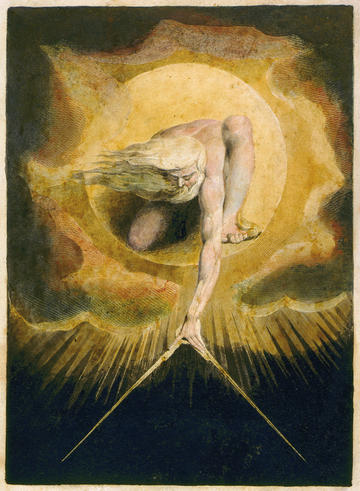
Image credit: U.S. Library of Congress - The Ancient of Days, by William Blake
Thursday 5 February 2026, 5pm - 6.30pm
Followed by drinks at the Reuben College bar
Lecture Theatre, Reuben College
Convenors: Angeliki Kerasidou, Associate Professor in Bioethics, Reuben College Official Fellow; Andrew Moeller, Project Leader, Biotechnology and the Humanities, TORCH
Description
Join us for a wide-ranging discussion on the surprising resurgence of interest in Christianity within Silicon Valley and amongst developers of artificial intelligence.
Our panel of experts will explore questions such as:
- What are the various factors driving the renewed curiosity?
- How might the ascribing of attributes to artificial intelligence that have typically been ascribed to a higher power (such as "omnipotence" and "omnipresence") both inform and distort our understandings of the potentials of AI?
- What role might religion play in challenging and guiding the development of artificial intelligence?
- What is both possible and desirable as it relates to aspirations for transcendence through technology, particularly in relation to the "merging" of the human brain with artificial intelligence?
This is a Reuben College Values&Society theme event, also supported by the Oxford Medical Humanities Research Hub.
Panellists:

Andrew Davison, theologian (University of Oxford)
Andrew began his academic journey at Oxford, reading Chemistry as an undergraduate, before completing a DPhil in Biochemistry. He subsequently studied theology at Cambridge. Following a curacy in Southeast London, he returned to Oxford to begin a career in theological teaching and research, first as Tutor in Christian Doctrine at St Stephen’s House and later in a similar role at Westcott House, Cambridge. During this period, he completed a Cambridge PhD on conceptions of finitude in Thomas Aquinas and John Duns Scotus. He went on to become the Starbridge Lecturer, later Professor, in Theology and Natural Sciences at the University of Cambridge (2014–24) and served as a visiting fellow at the Center of Theological Inquiry in Princeton, New Jersey (2022–24). In September 2024, he was appointed Regius Professor of Divinity at Oxford, a post based at Christ Church, where he is also a residentiary canon of the cathedral.
Louisa Clarence-Smith, journalist (The Times)
Louisa is US business editor at The Times, covering companies across America and chasing after the characters who lead them. Previously, she served as chief business correspondent and in 2021 she was jointly named Young Journalist of the Year at the Wincott Awards for business, economic and financial journalism. She lives in New York.

Bartek Papiez, artificial intelligence researcher (University of Oxford)
Bartek leads multidisciplinary research at the intersection of artificial intelligence, biomedical imaging, and health data science. At Oxford’s Big Data Institute, he directs the Machine Learning & Biomedical Data Research Lab, where his team develops new algorithms for image analysis, data integration, and robust machine learning. A key focus of his work is combining medical images with other sources of information—such as genetic data, electronic health records, and natural language—to address pressing challenges in medicine and population health. His projects span disease monitoring, the discovery of new treatment targets, and advances in cancer imaging. By uniting cutting-edge AI with real-world biomedical data, Bartek’s research aims to deepen disease understanding, enable earlier diagnosis, and support more precise treatments.
Sponsors